
The Australian housing crisis is leaving renters young and old struggling to secure safe, affordable homes. Our own research reveals that 60% of tenants aged 55–69 experience housing stress, compared with 53% of those aged 18–35.¹,²
These findings expose the challenges of retiring without owning a home in a system that assumes you will. Today, many tenants are approaching retirement alongside rising rents, limited savings and little protection.
Home in Place is on a mission to change that. Here, we explore the housing crisis in Australia, its latest statistics, consequences for older renters and the steps we can take towards positive change.
Key takeaways
- Rental affordability is a major issue. While rent increases have eased in some areas, many Australians still struggle to find homes they can afford.
- More Australians are renting later in life. The number of low-income renters aged 50 and over is expected to grow to 839,000 by 2032.
- Older pensioners have few affordable options, with just 0.2% of advertised rentals being affordable for a single person on the Age Pension.
- Many older renters fall through the housing system’s gaps, earning too much to qualify for assistance but not having enough savings to afford a secure home.
- Housing costs are changing retirement plans. Home in Place’s 2026 survey found that three in five older renters experience rental stress, and nearly one in five believe they may never retire.
- There is an urgent need for more social and affordable housing. Our One in Ten strategy calls for at least one in every ten new homes to be social or affordable housing, helping more Australians find a secure home as they age.
Australia’s housing crisis statistics: the latest figures on rental affordability
Australia’s rental affordability crisis is showing early signs of stabilisation after many years of rising costs.³ That said, low- and moderate-income households are still finding it difficult to make ends meet.
While the 2025 Rental Affordability Index found that affordability had levelled out in major cities like Sydney, Melbourne and Adelaide, conditions vary across the country.
For example, Perth is now Australia’s least affordable capital for renters, with median rent consuming 32% of an average renting household’s income, up from 21% in 2020. Meanwhile, regional Western Australia recorded the sharpest annual decline in affordability nationwide.³
And despite signs of stabilisation in some areas, rental rates are still on the rise. Nationally, rents increased by 3.6% in the year to August 2026.⁴
Therefore, while the pace of growth has eased, this offers little relief to those already experiencing rental stress. Keep reading to learn why housing costs continue to consume a significant share of many households’ income.
What’s causing the Australian housing crisis?
Australia’s housing crisis stems from several factors, including restrictive land-use planning, the end of the National Rental Affordability Scheme (NRAS), a rising cost of living, and a shortage of affordable homes.
Together, these pressures have pushed housing costs beyond what many Australians can afford. Let’s take a look at each one.
Land-use planning controls
Australia has struggled to build enough homes in areas where people want to live, particularly near employment, transport and essential services. Despite the country’s size, much of the demand for housing is concentrated in major cities.
As available land in these areas becomes more valuable, restrictions on building heights, housing density and minimum lot sizes can limit how many homes developers can build.
For example, research from the Grattan Institute found that around 80% of residential land within 30 kilometres of central Sydney and 87% in Melbourne is restricted to buildings of three storeys or fewer.⁵
Lengthy approval processes add further costs and delays. Combined with higher construction expenses, labour shortages and financing costs, these barriers can make new housing developments less viable.
When housing construction fails to keep pace with demand, competition for existing properties increases, placing upward pressure on prices and rents.
The end of the NRAS
Introduced in 2008, the NRAS encouraged investment in affordable rental housing by providing financial incentives to property owners who rented homes to eligible low- and moderate-income households at least 20% below market rates.
This scheme supported more than 38,000 affordable rental homes before officially ending on 30 June 2026. After the government stopped funding new allocations, properties gradually exited the program as their incentives expired.
The closure of the NRAS has created further challenges for Australia’s affordable housing supply. Without these incentives, some former NRAS properties may return to market rents, reducing the number of options available to eligible households.
A higher cost of living
Rising living costs are stretching household budgets, making it harder to cover rent or mortgage repayments alongside essentials like groceries, electricity and healthcare.
Higher interest rates have also increased mortgage costs for landlords, some of whom try to recover these expenses through rent increases.
Together, these pressures leave tenants less able to pay for housing, pushing affordable homes further out of reach.
More competition between renters
Australia’s growing population has increased demand for rental housing in a market already struggling with limited supply.
At the same time, high property prices and deposit requirements have kept many prospective first-home buyers renting for longer.
This means more households are competing for available properties. When demand outstrips supply, renters have fewer choices and less negotiating power.
Housing policy that isn’t designed for low incomes
Building more private rental properties is important, but increased supply doesn’t necessarily translate to more affordable homes for low-income Australians.
Anglicare Australia’s 2026 Rental Affordability Snapshot assessed 48,776 advertised rental listings nationwide, reporting that affordability for minimum wage earners, JobSeeker recipients and other low-income cohorts has hit record lows.⁶
This data exposes a critical gap in Australia’s housing market. More private rental properties may be available, but many remain out of reach for households on limited incomes.
Without greater investment in social and affordable housing, low-income renters risk being priced out of suitable homes and pushed towards overcrowded, insecure or inadequate accommodation.

How the housing crisis is affecting older renters
Australia’s housing crisis is leaving many older renters facing higher housing costs, fewer savings and greater financial uncertainty as they enter retirement.
Research from the Australian Housing and Urban Research Institute (AHURI) identified 640,970 low-income renters aged 50 and over in 2016, a figure projected to reach 839,123 by 2032.7 In NSW, Queensland and Victoria, more than 40% of this cohort live in private rental housing, exposing them to rising rents and housing insecurity.
For Age Pension recipients, secure and affordable housing options are scarce. For example, a median-priced one-bedroom home consumes over 40% of a single pensioner’s income in every capital city.³ Pensioner couples face similar challenges, with median rents taking up 38% to 57% of their income in urban areas.³
The shortage of affordable rentals makes matters even worse. Anglicare’s 2026 report found that just 0.2% of advertised properties were affordable for single Age Pension recipients, rising to only 0.7% for pensioner couples. Of the 88 listings affordable to single pensioners, 71 were rooms in share houses.⁶
With so few feasible options, older renters often have to compromise on accessibility, independence or suitable accommodation, increasing their risk of housing stress and homelessness in later life.
The Retirement Reckoning: Home in Place’s 2026 survey
Home in Place’s own research reinforces the above findings. Our recent survey, conducted by PureProfile among 772 tenants aged 55 to 69, highlights how rising rents are threatening financial security in retirement:
- 60% spend more than 30% of their income on rent, with a third spending over 40%.
- 27% expect serious financial stress in retirement, while just 8% anticipate a comfortable retirement.
- 18% believe they may never retire.
- 52% are already cutting back on groceries and social activities, while 25% are reducing spending on healthcare and medication.
- 73% worry about future housing insecurity, with one in five already feeling insecure in their current home.¹
These numbers also show how the weight of the housing crisis extends well beyond accommodation costs. Many older renters are sacrificing everyday essentials to keep a roof over their heads, with little confidence that retirement will bring financial relief.
The problem with rising rents in later life
Australia’s pension system has long assumed retirees own their own home. Yet, with the surge in rent and living costs, that’s no longer the case. Over the next decade, at least 750,000 Australians are expected to reach retirement age without being on the property ladder.¹
This is a major issue, with over 42% of surveyed renters aged 55-69 saying they can’t afford private rent on the Age Pension. Additionally, 34% believe their superannuation would last less than five years if they relied on it while renting.¹
Our housing support system hasn’t kept pace with this shift, either, leaving many older renters unable to afford market rents but ineligible for assistance.
Swinburne University has identified a growing group of older Australians who earn too much to access some forms of housing assistance but lack the savings to secure suitable housing independently.⁸
When asked what they would do if they could no longer afford their rent, survey respondents considered moving to cheaper areas, staying with family or relying on temporary accommodation. More than a quarter didn’t know what they would do.¹
Continuing to work might seem like another option, but employment offers little certainty. Our survey found that 47% of older renters lacked confidence in finding steady work if they needed a new job, while 32% reported being overlooked for employment because of their age.¹
That’s cause for major concern. For older renters, losing an affordable home can mean far more than relocating. It disrupts access to healthcare, community connections and the support they increasingly rely on as they age.
As Martin Kennedy, Home in Place’s Group Executive Manager of Marketing & Public Affairs, warns, “Lack of home ownership is one of the strongest predictors of poverty later in life.”
This risk is already apparent. At the 2021 Census, 19,378 people experiencing homelessness were aged 55 and over.⁹
Combatting our housing crisis with the One in Ten strategy
The number of households aged 55 and over needing affordable housing is expected to increase 120% from 200,000 in 2016 to 440,000 by 2031.¹⁰
Meeting this demand requires more social and affordable housing, and the need is urgent. After all, many older renters approaching retirement have limited time and opportunities to build savings or enter the property market.
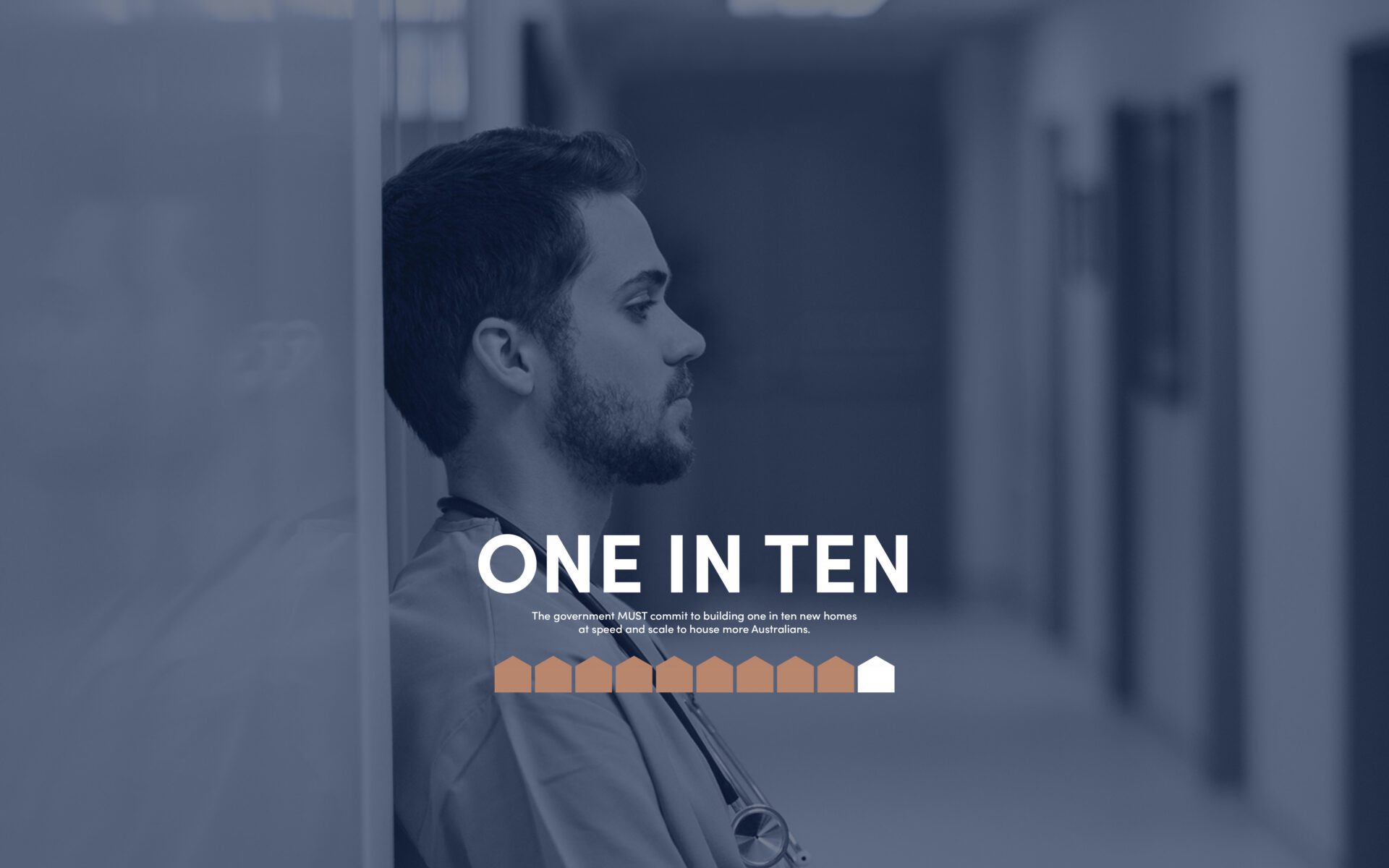
To close this gap, Home in Place’s One in Ten campaign calls on the Australian Government to ensure at least one in every ten new homes is social or affordable housing.
Instead of relying on short-term funding, our strategy proposes a structural shift with an ongoing target that scales with development. As more homes are built, the number of social and affordable properties would grow alongside them.
This proposal has strong support among older renters, with 80% of survey respondents in favour of increasing government investment in social and affordable housing.¹
It’s a commitment that would give retirees greater security today, while building a more resilient housing system for the generations that follow.
FAQs
Top-
Australia’s housing crisis refers to the growing difficulty of finding and keeping a safe, appropriate and affordable home. Rising property prices, high rents and a shortage of available housing have placed mounting pressure on households across the country.
This crisis affects both homeowners and renters, especially low-income earners, first-home buyers, older Australians and people at risk of homelessness. For many, it means spending more of their income on accommodation, struggling to enter the property market and facing greater housing insecurity.
-
Housing stress occurs when accommodation costs take up a significant share of household income, leaving less money for essentials such as food, healthcare and transport.
In Australia, the commonly used ’30/40 rule’ identifies households in housing stress when they fall within the lowest 40% of the income distribution and spend over 30% of their gross income on housing costs. This measure applies to both renters and homeowners with mortgages.
-
Australian renters spend approximately 20% of their gross household income on rent, according to the Australian Bureau of Statistics (ABS) 2019–20 Survey of Income and Housing.¹¹
For lower-income households renting privately, this figure rose to around 32%, exceeding the typical rental stress threshold of 30%.
While rental affordability varies by location and household circumstances, these historical figures show how housing costs can place more pressure on people with limited incomes.
-
Older Australians on low incomes who rent privately are at high risk of housing stress. More specifically, research has found that women aged 50 to 65, especially those living alone and outside the workforce, are more likely than older men to experience unaffordable or poor-quality private rental housing.⁷,⁸
Across Australia, this demographic is more likely to live in private rentals than social housing, leaving them vulnerable to rising rents and competition for affordable properties.¹²
-
One proposed reform is to review the Age Pension assets test to better support older renters and address differences between homeowners and non-homeowners.¹¹
Currently, a family home is generally exempt from the assets test. While non-homeowners have higher asset thresholds, ongoing rental costs can eat into retirement savings.
Adjusting pension taper rates, which determine how payments decrease as assets increase, could also improve fairness. Any changes would need to balance government costs with incentives to save for retirement.
The table below compares the assets test thresholds for homeowners and non-homeowners, effective from 20 September 2026.¹⁴
Household type Homeowner Non-homeowner Full pension: maximum assessable assets Single person $333,000 $600,000 Couple (combined) $499,000 $766,000 Part pension: assets cut-off Single person $745,750 $1,012,750 Couple (combined) $1,121,000 $1,388,000 Source: Services Australia, Assets test for Age Pension, thresholds effective 20 September 2026. © Commonwealth of Australia, licensed under CC BY 4.0. Figures are a guide only. Check current limits with Services Australia, as thresholds are indexed several times a year.
-
Demand for Commonwealth Rent Assistance (CRA) is expected to rise as more Australians reach retirement without owning a home.
It’s estimated that the number of Australians aged 55 and over eligible for CRA will increase by 60%, from 414,000 in 2016 to 664,000 by 2031.¹⁵
Over the same period, annual government spending on CRA for this age group is forecast to rise from $972 million to $1.55 billion.¹⁵
As more older Australians depend on rental assistance, demand for social and affordable housing is also likely to grow. This could place further strain on government budgets and widen financial inequalities between homeowners and renters.¹³,¹⁶
-
Yes. The housing crisis is likely to have lasting consequences for the next generation, with rising costs making it harder for younger Australians to buy a home and build financial security before retirement.
Home ownership has fallen from 73% in 1966 to 66% at the 2021 Census.17,18 Research projects a further decline to around 63% by 2040, with just over half of households aged 25 to 55 expected to own their homes.¹⁶
As more Australians enter the property market later or rent for longer, they may retire with more mortgage debt, fewer savings or ongoing rental costs.¹³ Without improvements in housing affordability and supply, this could mean even greater financial insecurity.
-
The housing crisis affects Australians of all ages. Without systemic improvements to affordable housing supply, a growing number of us will enter retirement without a stable home.
At Home in Place, we believe everyone deserves access to safe, secure and affordable housing, regardless of their life stage or income.
That’s why our One in Ten strategy calls for an ongoing government commitment to increasing social and affordable housing across Australia. This sustained investment will give more people the opportunity to age with dignity and independence.
Learn more about our campaign, contact your local member of parliament, or share this article to raise awareness of the challenges facing older renters.
References
- PureProfile 2026, The Retirement Reckoning, survey conducted for Home in Place, March.
- Home in Place 2025, The Exit Generation: Findings from the Home in Place Youth Housing Survey, Home in Place, September.
- SGS Economics & Planning 2025, ‘Rental Affordability Index 2025: Signs of stabilisation, but pressures remain high’, SGS Economics & Planning, 21 November. Available at: https://sgsep.com.au/publications/insights/rental-affordability-index-2025
- Australian Bureau of Statistics (ABS) 2026, Consumer Price Index, Australia, August 2026, ABS, 30 September. Available at: https://www.abs.gov.au/statistics/economy/price-indexes-and-inflation/consumer-price-index-australia/aug-2026
- Coates, B. 2026, ‘The housing crisis that Australia built’, Grattan Institute, 11 March. Available at: https://grattan.edu.au/news/the-housing-crisis-that-australia-built/
- Anglicare Australia 2026, Rental Affordability Snapshot 2026: National Report, Anglicare Australia, April. Available at: https://www.anglicare.asn.au/wp-content/uploads/2026/04/Rental-Affordability-Snapshot-2026-National-Report.pdf
- Barrie, H., Cebulla, A., Lange, J., Faulkner, D. and Sharam, A. 2023, Mapping Australia’s older, low-income renters, AHURI Final Report No. 405, Australian Housing and Urban Research Institute Limited, Melbourne. Available at: https://www.ahuri.edu.au/research/final-reports/405. DOI: 10.18408/ahuri3225101.
- Veeroja, P., Reynolds, M. and Stone, W. 2024, Not poor enough, not rich enough: Older people falling through the housing assistance eligibility gap, Swinburne University of Technology. Available at: https://doi.org/10.25916/sut.27208371.
- Australian Bureau of Statistics (ABS) 2023, Estimating Homelessness: Census, 2021, ABS, 22 March. Available at: https://www.abs.gov.au/statistics/people/housing/estimating-homelessness-census/latest-release#older-australians-experiencing-homelessness
- Ong, R., Wood, G., Cigdem-Bayram, M. and Salazar, S. 2019, Mortgage stress and precarious home ownership: Implications for older Australians, AHURI Final Report No. 319, Australian Housing and Urban Research Institute Limited, Melbourne. Available at: https://www.ahuri.edu.au/research/final-reports/319. DOI: 10.18408/ahuri-8118901.
- Australian Bureau of Statistics (ABS) 2022, Housing Occupancy and Costs, Australia, 2019–20, ABS, 25 May. Available at: https://www.abs.gov.au/statistics/people/housing/housing-occupancy-and-costs/latest-release
- Reynolds, M., Parkinson, S., De Vries, J. and Hulse, K. 2024, Affordable private rental supply and demand: Short-term disruption (2016–2021) and longer-term structural change (1996–2021), AHURI Final Report No. 416, Australian Housing and Urban Research Institute Limited, Melbourne. Available at: https://www.ahuri.edu.au/research/final-reports/416. DOI: 10.18408/ahuri5128501.
- Whelan, S., Atalay, K. and Dynan, L. 2018, Asset portfolio retirement decisions: The role of the tax and transfer system, AHURI Final Report No. 298, Australian Housing and Urban Research Institute Limited, Melbourne. Available at: https://www.ahuri.edu.au/research/final-reports/298. DOI: 10.18408/ahuri-7311201.
- Services Australia 2026, ‘Assets test’, Services Australia, Australian Government, 20 September. Available at: https://www.servicesaustralia.gov.au/assets-test-for-age-pension?context=22526
- Ong ViforJ, R., Wood, G., Cigdem-Bayram, M. and Salazar, S. 2019, ‘Fall in ageing Australians’ home-ownership rates looms as seismic shock for housing policy’, The Conversation, 27 August.
- Burke, T., Nygaard, C. and Ralston, L. 2020, Australian home ownership: Past reflections, future directions, AHURI Final Report No. 328, Australian Housing and Urban Research Institute Limited, Melbourne. Available at: https://www.ahuri.edu.au/research/final-reports/328. DOI: 10.18408/ahuri-5119801.
- Australian Institute of Health and Welfare (AIHW) 2017, Australia’s welfare 2017, Chapter 6.3, ‘The changing shape of housing in Australia’, AIHW, Canberra. Available at: https://www.aihw.gov.au/getmedia/54616413-166f-4048-b886-c901bf8afce1/aihw-australias-welfare-2017-chapter6-3.pdf.aspx
- Australian Bureau of Statistics (ABS) 2022, Snapshot of Australia, 2021, ABS, 28 June. Available at: https://www.abs.gov.au/statistics/people/people-and-communities/snapshot-australia/2021


