

Secure accommodation for low to moderate-income households facing rental stress
If you’re struggling to keep up with rising rents but do not qualify for social housing, affordable housing may be a suitable solution. These homes are designed for tenants with a steady income who still experience housing stress in the private rental market.
Home in Place provides affordable housing, with properties available in a number of locations and eligibility requirements varying by program and location.
Our affordable housing properties are professionally managed, with many delivered in partnership with government and other organisations to help provide more secure and affordable rental options.
Whether you’re finding it difficult to manage rising rental costs, trying to stay close to work or seeking a more stable home for your household, explore our affordable housing options and current vacancies to find out what may be available in your area.

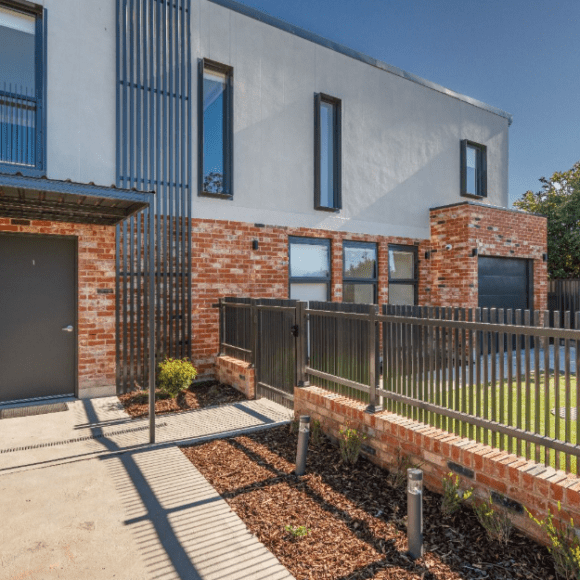
What is affordable housing?
Managed by charities and community housing providers such as Home in Place, affordable housing is offered at a rebated rent to low to moderate-income workers, who would otherwise experience housing stress in the private rental market.
Rents in affordable housing properties are capped at between 75% and 80% of the assessed market rate for the property in question.
With social housing now almost exclusively reserved for the most vulnerable members of society, affordable homes have emerged as an alternative for low-income workers.
The transitional aspect of affordable housing encourages tenants to pursue real property ownership while paying reasonable rent in their present circumstances. This has delivered terrific outcomes, with tenants obtaining private home ownership through this program.
Affordable housing can be supported through a range of federal and state government programs, which may change over time. These have included initiatives such as the National Rental Affordability Scheme, Building Better Cities, Debt Equity Funding arrangements, the Social Housing Growth Fund and the NSW Government’s Social and Affordable Housing Fund.
In addition to government programs, Home in Place also invests directly in affordable housing through debt finance and by leveraging its asset portfolio to support the development and management of new homes.
Eligibility criteria for affordable rental housing
To be eligible for affordable housing:
- You must be an Australian citizen, a permanent resident or have a valid visa to reside in Australia.
- You must have a connection with the area in which you are applying for housing. This could be through work, education, family or long-term residency.
- You are a low-moderate income earner.
- There is no outstanding debt to Home in Place, Housing NSW, or any other Community Housing provider.
- You must be earning below the tenant income level relevant to your household type. An up-to-date and extensive list of example household income limits set by the NSW Government can be found here. Income eligibility limits on properties receiving National Rental Affordability Scheme (NRAS) funding are outlined on the DSS website here.
Household income limits are indexed annually on 1 May in accordance with the NRAS tenant income index.
Some Affordable Housing Programs have specific eligibility criteria. You will be advised of any additional criteria on enquiry.
What are the income limits for affordable housing?
Affordable housing is available to households within very low, low and moderate income bands.
Income eligibility limits, or thresholds, are determined by household size and total income.
In NSW, two median income measures are used to set the eligibility limits:
- One is for people living in the Sydney and surrounding regions, including Central Coast LGA to the north, Blue Mountains LGA to the west and Wollondilly to the south
- The other is for people living in the rest of NSW
Special consideration is given to a household’s location and composition when considering the income limits. The NSW Ministerial Affordable Housing Guidelines set out the Household Income Eligibility Limits by household composition, income and region. The income limits for NRAS properties are slightly different from the general limits – both are available to download and view here.
Some Affordable Housing Programs have specific eligibility criteria.
Explore and apply for affordable housing
All Home in Place affordable housing vacancies are advertised on realestate.com under the relevant locations.
Prospective applicants are strongly encouraged to attend the scheduled Open Home inspections for each property. During the inspections, we can answer any questions you have about the property, discuss your eligibility, and provide you with an application form.
If you cannot attend a scheduled Open Home inspection, you can call our Customer Call Centre on 1300 333 733.
Our friendly team will be able to provide you with more information on the property and the program requirements, and if applicable, email you a copy of the relevant application form.
Lynda and Colin’s Story

FAQs
Top-
The difference between affordable housing and social housing is who the accommodation supports and how rent is calculated.
Social housing is intended for people with the highest and most urgent housing needs, including those experiencing homelessness, disability or severe financial hardship. Rent is usually set at around 25% of a tenant’s household income, which helps ensure housing remains affordable for people with very limited financial resources.
On the other hand, affordable housing is designed for low to moderate-income households who may be working or receiving a regular income but still cannot afford typical private rental prices.
Instead of being based on income, rent is usually set below the market rate for the property. This allows tenants to live in secure housing while reducing rental stress and staying connected to work, education and their local community.
-
Affordable housing is generally significantly cheaper than renting the same type of property on the private market. In many programs, rent is capped at around 75 to 80% of the market rent for that property.
This reduced rent helps households who are experiencing rental stress manage their housing costs while still living in quality homes.
The goal is to make renting more manageable without removing the responsibility of paying rent, allowing tenants to maintain financial stability while living in secure housing.
-
No. You do not need to be on the social housing register to apply for affordable housing. Affordable housing programs are separate from the social housing system.
You can express interest in available properties and submit an application if you meet the eligibility criteria.
-
Yes, casual and part-time workers can apply for affordable housing. The most important factor is whether your total household income falls within the eligibility limits.
During the application process, you’ll need to provide documents showing your income, such as recent payslips, employment statements or tax records, so your eligibility can be assessed.
-
We encourage all potential tenants to attend a scheduled inspection or open home before applying for an affordable housing property.
Attending an inspection allows you to view the home in person, confirm that it suits your household and ask any questions about the tenancy or application process. Housing staff may also provide application forms or explain the eligibility requirements during the inspection.
If you cannot attend the inspection, please contact our team to discuss the property and request information about how to apply. We will be able to guide you through the next steps.
-
You can usually stay in affordable housing as long as you continue to meet the eligibility requirements and comply with your tenancy agreement.
Remember that affordable housing aims to provide stable, long-term rental options rather than short-term accommodation. For many households, it offers several years of stability while they improve their financial position.
As a tenant, you may be asked to complete regular income reviews to confirm you still qualify for the program. If household income increases significantly and exceeds the eligibility limits, we may review the tenancy arrangement.
-
Yes, it may be possible to move to another affordable housing property if your household circumstances change and a suitable property becomes available.
For example, you may need a larger home if your household grows, or a smaller property if fewer people are living with you.
In these situations, please speak with our team about your needs and whether a transfer is possible. Transfers are not always guaranteed and depend on property availability and continued eligibility for the affordable housing program.


