

Many people envision homelessness as someone living on the street. But there are many different types of homelessness that aren’t as visible.
The Australian Bureau of Statistics (ABS) defines a person as homeless if they lack access to safe, stable, and adequate housing.
For some, this may mean sleeping rough. For others, homelessness looks like a family crammed into an overcrowded room because they can’t afford rent. It looks like a teenager bouncing from one friend’s couch to another, never knowing where they’ll sleep next. It looks like a mother and her baby living in a motel, desperate for a permanent home but stuck in limbo.
This hidden homelessness is just as real, just as urgent, and just as devastating as sleeping rough. But to truly support people facing such challenges, we need to understand the signs and causes of each experience.
In this article, we explore the different types of homelessness in Australia based on living conditions and duration—plus how Home In Place is working to provide safe and secure housing for those in need.
Defining homelessness
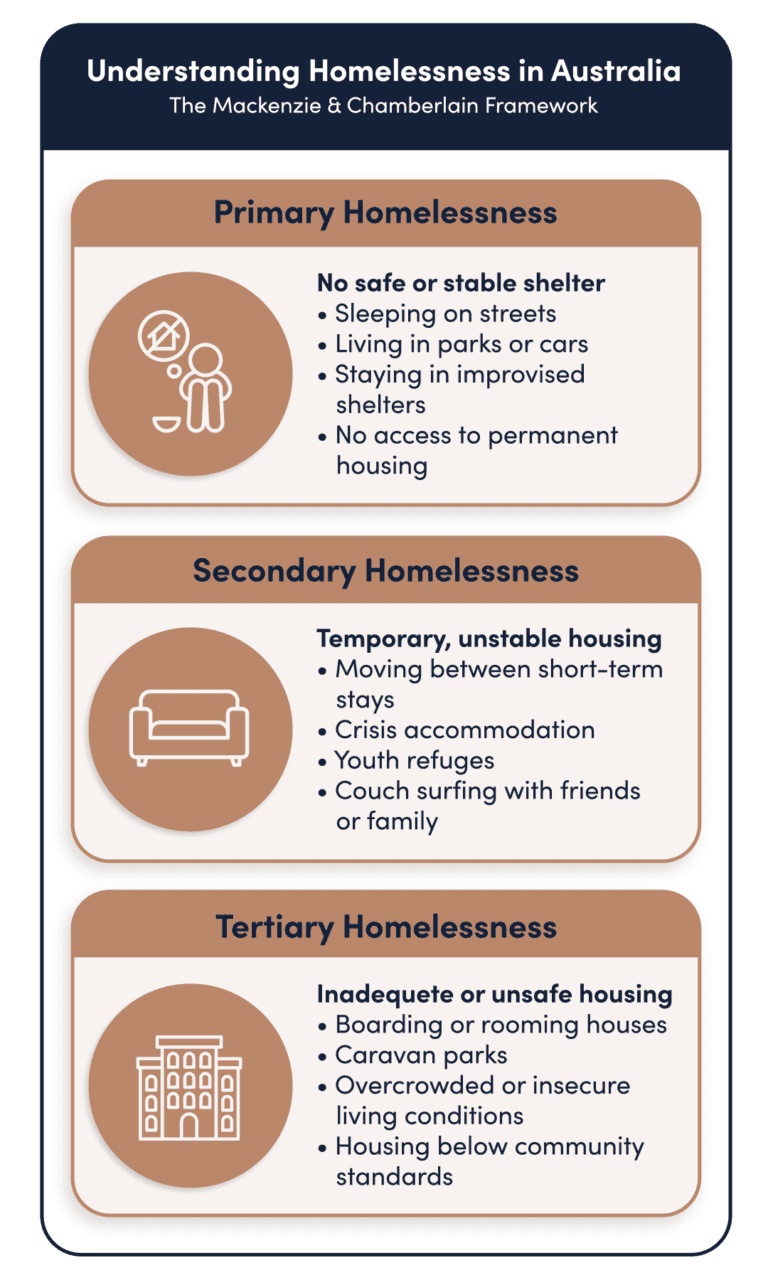
According to Mackenzie and Chamberlain1, homelessness can take many forms under three broad categories:
- Primary homelessness refers to people who have no safe or stable place to live. This includes sleeping on the streets, in parks, in cars, or in makeshift shelters that aren’t designed for long-term living.
- Secondary homelessness describes people who move regularly between short-term lodgings. They may rely on crisis accommodation, youth refuges, emergency shelters, or couch surfing with friends or family.
- Tertiary homelessness applies to people living in accommodation that doesn’t meet basic community standards. This can include some boarding houses, rooming houses, or caravan parks where conditions are overcrowded, dangerous, or insecure.
Let’s take a closer look at the various living conditions faced by Australia’s homeless population every day.
Types of homelessness based on living conditions
The Australian Bureau of Statistics (ABS) categorises homelessness into six distinct groups based on living circumstances:
- Rough sleeping: People residing in makeshift shelters such as tents, cars, or open spaces without adequate protection.
- Crisis and supported accommodation: Those staying in temporary housing services, including shelters and emergency lodgings.
- Couch surfing: People relying on friends, family, or acquaintances for short-term stays due to a lack of permanent housing. This is a common form of youth homelessness.
- Boarding house residents: Individuals renting single rooms in boarding houses with shared facilities and often insecure tenancy conditions.
- Other temporary accommodation: Those living in short-term lodgings such as motels, hostels, or caravan parks because they lack access to stable and affordable housing.
- Severely crowded dwellings: Households requiring at least four additional bedrooms to accommodate all occupants.
Let’s take a closer look at each type of homelessness.
Rough sleepers
Rough sleeping is the most visible and extreme form of homelessness. It includes people without any shelter, relying on improvised dwellings such as tents, cars, or abandoned buildings.
With no protection from the elements and little access to basic amenities like toilets and showers, rough sleepers often face severe health risks, including exposure to harsh weather, malnutrition, and increased vulnerability to violence.
Many rough sleepers have experienced long-term homelessness, often as a result of complex social relations and economic factors. Mental illness, family violence, job loss, and a lack of affordable housing all contribute to people finding themselves in this dire situation.
While emergency relief services and crisis accommodation exist, breaking the cycle of rough sleeping requires long-term solutions such as supportive housing and wraparound care services.
Supported accommodation
Supported accommodation provides a temporary safety net for people experiencing homelessness.
These facilities include crisis shelters, transitional housing, and other emergency accommodation operated by charities, government agencies and community organisations like Home In Place.
They offer not just a roof but also essential support services—such as mental health care, addiction treatment, and employment assistance—to help individuals regain stability.
While these programs aim to be a stepping stone towards permanent housing, supported accommodation services are often overwhelmed by demand, with limited spaces available. The ongoing shortage of affordable long-term housing means that some individuals remain in crisis accommodation for extended periods.
Couch surfing
Couch surfing is one of the least visible yet most common forms of homelessness.
Unlike rough sleeping, it often goes unreported because it doesn’t fit the traditional image of homelessness. Instead of sleeping on the streets, individuals in this situation rely on friends, family, or acquaintances for temporary shelter, moving frequently with no permanent home of their own.
While it may seem like a safer alternative to sleeping rough, couch surfing is far from stable. Many individuals find themselves bouncing between different households, never knowing how long they can stay in one place. This constant instability disrupts their ability to maintain employment, pursue education, and build a secure future.
Couch surfing is especially common among young adults fleeing family conflict, domestic violence, or financial hardship. Without a reliable support system or the means to secure housing, they are highly vulnerable to exploitation and further displacement.
For many, couch surfing is not just a temporary inconvenience; it can become a cycle that traps individuals in long-term housing insecurity.
Without access to stable and affordable housing options, what starts as a short-term solution can quickly turn into a prolonged struggle with homelessness.
And because they are not accessing shelters or government services, they often go uncounted in homelessness statistics—making it even harder for policymakers to address their needs.
Boarding houses
Boarding houses offer a form of temporary housing where individuals can rent a single room and share common facilities like kitchens and bathrooms.
People living in boarding houses often face similar challenges to those in crisis accommodation. They may be on low incomes, experiencing a mental health condition, or struggling with substance dependence.
While this might seem like an affordable housing option, many boarding houses operate in substandard conditions, with overcrowding, lack of privacy, and limited rights for tenants. Additionally, residents often have no formal lease agreements, leaving them vulnerable to eviction at short notice.
While some boarding houses are regulated and provide a reasonable standard of living, many fall into the category of marginal housing, which offers little stability or dignity for those in need.
Temporary accommodation, such as caravan parks or motels
When people cannot access permanent housing or shelters, they may be forced into other temporary lodgings like motels, caravan parks, or short-term hostels.
These options are often the last resort, used by families and individuals experiencing financial hardship or sudden displacement. While they provide a temporary solution, they are usually expensive, overcrowded, and lacking in essential facilities.
Many people living in this temporary shelter are caught in a cycle of housing insecurity. They may be unable to save for a rental bond or meet tenancy requirements due to irregular employment or past evictions.
Without proper intervention, these individuals stay in a state of limbo, unable to transition into stable, long-term housing.
Severely crowded dwellings
Severely crowded dwellings are the most common form of homelessness in Australia, accounting for nearly 44% of all cases in 2016. It refers to situations where a household requires at least four additional bedrooms to accommodate the people living there.
These conditions are particularly common among low-income families, migrant communities, and Indigenous Australians who face significant housing affordability issues.
In many cases, overcrowding is a direct result of the housing crisis, where people cannot afford to live independently and are forced into shared arrangements that strain their well-being and relationships.
While overcrowding may not seem as dire as sleeping rough, it has serious consequences. Lack of access to private dwellings with adequate space and facilities can lead to stress, poor health outcomes, and difficulties for children in education.
Types of homelessness based on duration
Homelessness is not a one-size-fits-all experience. Some people endure it briefly due to a sudden life event, while others find themselves trapped in a cycle of instability for years.
The length and frequency of homelessness can help us understand the challenges people face and the level of support they need to find stability.
Keep reading to discover the different types of homelessness based on duration.
Episodic homelessness
Episodic homelessness refers to individuals who have experienced at least three periods of homelessness over a year. Unlike those in chronic homelessness, these people may not be continuously unhoused but cycle in and out of unstable living situations.
Many facing episodic homelessness are minors and young adults struggling with mental illness, substance use disorders, or other health conditions that make maintaining stable housing difficult.
Without timely intervention, episodic homelessness can escalate into chronic homelessness, making it even harder for individuals to find secure housing.
Moreover, many people in this category work minimum-wage or seasonal jobs that do not provide financial stability, pushing them back into homelessness when employment ends.
Addressing episodic homelessness requires targeted support, including affordable housing, healthcare, and employment programs to break the cycle before it becomes permanent.
Transitional homelessness
The most common type of homelessness, transitional homelessness, occurs when individuals or families lose their housing due to a major life change, sudden catastrophic event or crisis. This could be a job loss, illness, domestic violence, separation, or economic hardship.
Those affected often lack financial resources or a support network to fall back on, forcing them to seek temporary housing solutions such as shelters, motels, or sleeping in their cars.
Young people are disproportionately affected by transitional homelessness, often moving between friends’ homes or sleeping in insecure locations. Many still hold jobs but cannot afford stable housing due to high living costs.
Because their situation is temporary, transitional homelessness can sometimes go unnoticed—making it difficult for those affected to access the support they need.
Without intervention, short-term homelessness can stretch into months or even years, increasing the risk of long-term instability.
Crisis and Transitional Accommodation Program
Across Australia, crisis accommodation services regularly reach capacity. Each year, women and children escaping family violence are turned away because there simply are not enough safe places available.
The Crisis and Transitional Accommodation Program was established to address this gap and strengthen pathways into stable, long-term housing.
Funded through the Australian Government’s $10 billion Housing Australia Future Fund (HAFF), this capital works initiative has committed $100 million over five years to support the delivery of up to 4,000 new homes.
Priority is given to women and children escaping family and domestic violence, and older women at risk of homelessness.
Grants can be used by government bodies and registered community housing providers to:
- Build new crisis or transitional accommodation
- Expand or refurbish existing facilities
- Buy and convert residential properties into supported housing
- Deliver eligible mixed-tenure developments that increase supply
By investing directly in crisis and transitional housing supply, this program aims to relieve pressure on emergency services and provide safer, more reliable stepping stones into permanent housing for women and children at risk.
Chronic homelessness
Chronic homelessness refers to individuals who have been continuously homeless for over a year or have had at least four periods of homelessness in the past three years.
People experiencing chronic homelessness often live in cars, parks, abandoned buildings, or on the streets, lacking access to stable and safe shelter.
Their situation is rarely the result of a single misfortune; rather, it is a complex web of systemic barriers, social disadvantage, and personal struggles that intensify over time.
This type of homelessness is often the most entrenched and challenging to escape, as it is typically linked to deep-rooted issues like severe mental illness, physical disabilities, addiction, and long-term trauma.
Many face significant health challenges that make it nearly impossible to maintain employment or access stable housing, trapping them in a cycle of homelessness that can last for years.
Breaking this cycle demands more than just temporary shelter—it requires comprehensive solutions, including permanent supportive housing, healthcare, and long-term rehabilitation services.
Addressing the root causes of chronic homelessness is key to providing those affected with the stability, dignity, and security they need to rebuild their lives.
Hidden homelessness
Hidden homelessness refers to people who do not have a home of their own but are not sleeping on the streets or in shelters. Instead, they rely on temporary arrangements with friends, family or acquaintances because they have no secure place to live.
In Australia, this often means couch surfing, rotating between households, or living in overcrowded homes to avoid rough sleeping. These arrangements may look stable from the outside, but they are usually fragile and fleeting. There is no lease, no certainty and often no privacy.
Typical features of hidden homelessness include:
- No legal right to stay
- Frequent moves with little notice
- Overcrowded or unsuitable living conditions
- Limited access to basic facilities
- Financial pressure despite low income
This experience is difficult to measure because many people in this situation don’t access specialist homelessness services. Consequently, they are underrepresented in official data like census forms. Their housing insecurity exists, but it remains largely out of sight.
Unfortunately, young people are particularly affected. Family breakdown, domestic violence, and financial hardship often push teenagers and young adults into couch surfing as a first step into youth homelessness.
Australia’s homelessness policy framework
Australia’s response to homelessness brings together frontline support services and long-term housing reform. Some programs fund crisis accommodation and social housing operations, while others are designed to increase the supply of affordable homes and ease pressure across the system.
At the centre of this framework is the National Agreement on Social Housing and Homelessness (NASHH), which began in July 2024. This agreement funds Specialist Homelessness Services and underpins the operation of social housing nationwide. Essentially, it keeps crisis accommodation, outreach services and tenancy support programs running.
Alongside this sits the National Housing Accord, which focuses on expanding affordable housing supply. The Accord sets a national target to deliver up to 20,000 new affordable homes over five years from 2024.
To help meet that target, the Government funds several key initiatives:
- Housing Support Program ($500 million): Funds enabling infrastructure, such as roads, sewerage, water and utilities, and bolsters planning capability so that new housing developments can move from approval to construction faster.
- New Home Bonus ($3 billion): Provides financial incentives to states and territories that exceed their agreed housing delivery targets.
- National Planning Reform Blueprint: Encourages zoning reform, increased land release and faster development approvals to remove structural barriers that limit housing supply.
Housing Australia, the Commonwealth’s housing agency, provides the finance and infrastructure support needed to deliver those homes. As well as the HAFF, its initiatives include the:
- Affordable Housing Bond Aggregator (AHBA): Provides low-cost, long-term loans to registered community housing providers so they can finance and deliver more social and affordable housing.
- National Housing Infrastructure Facility (NHIF): Provides grants and concessional loans for infrastructure and capital projects that unlock new housing supply, including crisis and transitional accommodation for people at risk of homelessness.
Together, these measures aim to reduce the different types of homelessness by assisting services today and increasing housing supply for the future.
However, current commitments still fall short of the scale of Australia’s housing crisis. The demand for social and affordable housing still exceeds supply.
That’s why Home In Place is championing the One in Ten policy, a call for one in ten new homes to be dedicated to social and affordable housing.
Learn why this target matters and how it could reshape Australia’s response to modern homelessness.
Find stable and affordable housing in Australia
From rough sleeping to couch surfing, understanding the different types of homelessness is crucial in addressing this issue effectively.
After all, having a safe and secure place to call home is a fundamental human right. Yet, for many Australians facing homelessness—whether due to a sudden crisis, ongoing instability, or long-term hardship—finding suitable accommodation can feel impossible.
At Home In Place, we are committed to changing that.
We provide community housing and affordable housing solutions to support individuals and families in need. We also offer emergency temporary accommodation to help those in crisis find stability during difficult times.
If you or someone you know is experiencing or at risk of homelessness, we’re here to help. Explore homes across New South Wales, Victoria, and Queensland, or contact our friendly team for personalised assistance today.
References
- Australian Bureau of Statistics (2011) The cultural definition of homelessness identifies shared community standards about the minimum housing that people have the right to expect, Australian Bureau of Statistics, https://www.abs.gov.au/ausstats/[email protected]/0/90db868e528d3eebca2578df00228cee?opendocument (accessed 20 February 2026).


